


Quality and Testing Metrics (QuaPik)
About the Client
The Federal Office for Information Security (Bundesamt für Sicherheit in der Informationstechnik, BSI) is Germany’s federal cybersecurity authority, continuously monitoring the state of IT security across the country. Its remit covers both the evolving threat landscape and the growing attack surface created by digitalization, as well as Germany’s collective resilience — advancing the country’s capacity to prevent, defend against, and recover from cyber threats. The BSI reports annually to the Federal Ministry of the Interior and to the German public on the national IT security situation.
Introduction
Prior to QuaPik, there were no rigorous testing methodologies available for rolled fingerprint scanners, smartphone fingerprint scanners or 3D facial scanners. Therefore, the goal of QuaPik was to establish a verified and stable set of metrics and testing methodologies for evaluating rolled- and smartphone-based fingerprints, as well as 2D- and 3D-facial images.
The outcome of this project delivered new quality metrics and methodologies to be integrated into technical guidelines and international standards by the BSI. Additionally, QuaPik resulted in a fully functional software solution that allows the uploading of biometric data that can be interactively visualized and evaluated. The software allows the BSI to directly implement the new quality metric and methodology findings. These results will help guarantee the interoperability of biometric scanning devices from different vendors and facilitate the introduction of common standards worldwide to guarantee interoperability in international crime investigations and cross-border travel.
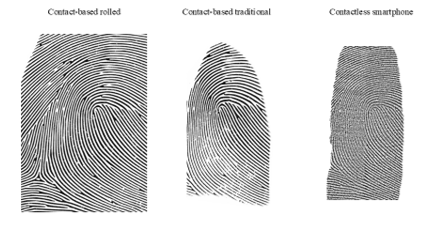
Figure 1. A contact-based rolled fingerprint, a contact-based traditional fingerprint, and a contactless fingerprint from a smartphone.
Testing Methodologies
As part of its BSI work, IDloop developed testing methodologies for two capture technologies that had no established evaluation framework: smartphone-based contactless fingerprint capture and 2D/3D facial recognition. Contactless fingerprinting offers real advantages over contact-based scanning — better hygiene, no latent prints, faster throughput, and less wear on the device — and smartphones make it attractive at scale. But because manufacturers do not disclose their camera optics or internal image processing, there is no guarantee that the resulting image faithfully represents the fingerprint.
The project therefore built reference-based and non-reference-based quality metrics, derived technical requirements aimed at interoperability with legacy contact-based prints, and validated them against both real and synthetic finger targets using a robotic test rig. The parallel workstream defined minimum camera requirements and a comprehensive test methodology for 1:1 face verification, evaluating how lighting and motion affect 2D and 3D systems.
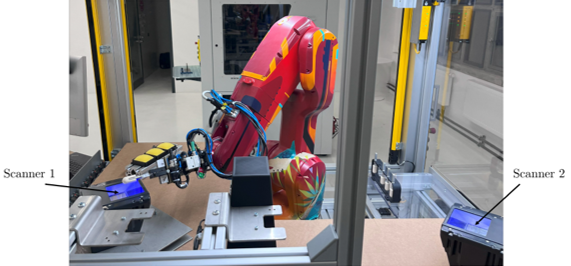
Experimental set-up: a robotic arm wielding a finger target for fingerprint acquisition with two contact-based 2D fingerprint scanners.
Key takeaways:
Upon the completion of QuaPik, quality and testing metrics were developed in these three areas with the intention to integrate the results in current technical guidelines and standards. These results will help to establish comparability of biometric scanning devices from different vendors. Furthermore, QuaPik results are the first steps towards enabling interoperability of fingerprints taken with different methods (contact-based, contactless, rolled and pressed).
As consortium leader, IDloop demonstrated its skills in understanding, developing, and applying common standards for biometric systems throughout the project. Using technical knowledge combined with analytical skills, IDloop envisions contributing to similar projects in other biometric modalities, such as iris-scanning, vein patterns, and palm-scanning, in the future. IDloop fully supports the high standards that BSI perpetuates in the field of biometrics and is proud to help advance these standards through testing and research.