
The technology that powers CFS
Light as a Measuring Instrument

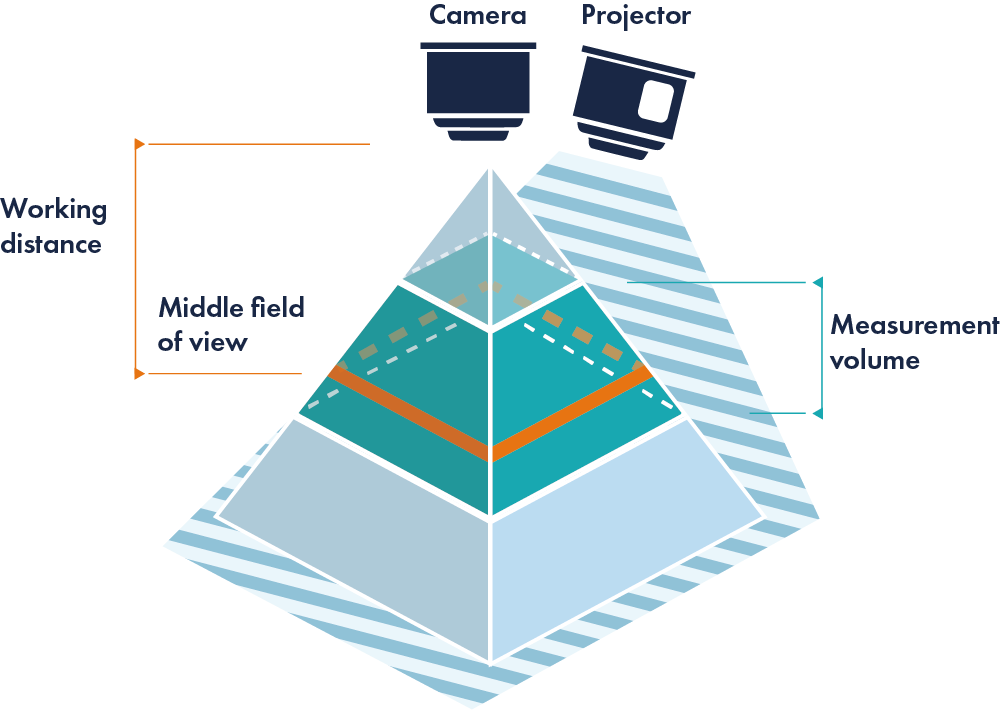
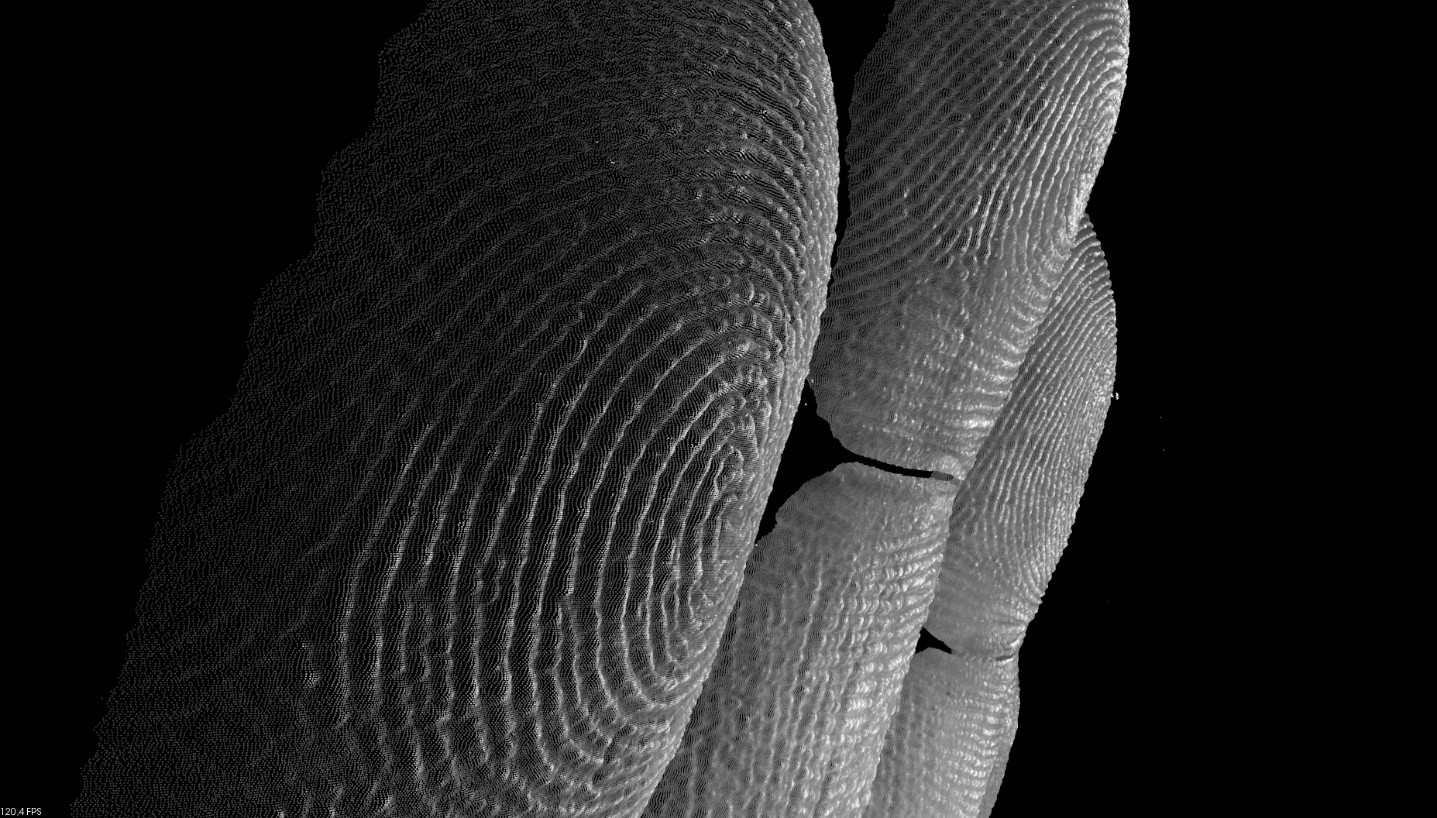
The principle is called structured light projection. A precisely defined pattern of blue light is projected onto the surface of the finger. Because a fingerprint is not flat. It’s a complex, three-dimensional landscape of ridges, valleys, and curvature — the projected pattern deforms as it conforms to that surface.
A high-resolution camera captures this deformed pattern in real time. From the nature and degree of that deformation, the system mathematically reconstructs the exact 3D geometry of the fingerprint surface through triangulation — the same geometric principle used in precision engineering and industrial metrology.
The result: a complete 3D point cloud of the finger’s surface, built from up to eight million data points, captured in a single non-contact scan.
Utilizing blue light to resolve the finest surface details of a fingerprint, gives IDloop’ bluelynes® technology its micron-scale precision advantage.
3D Capture. 2D Compatibility.
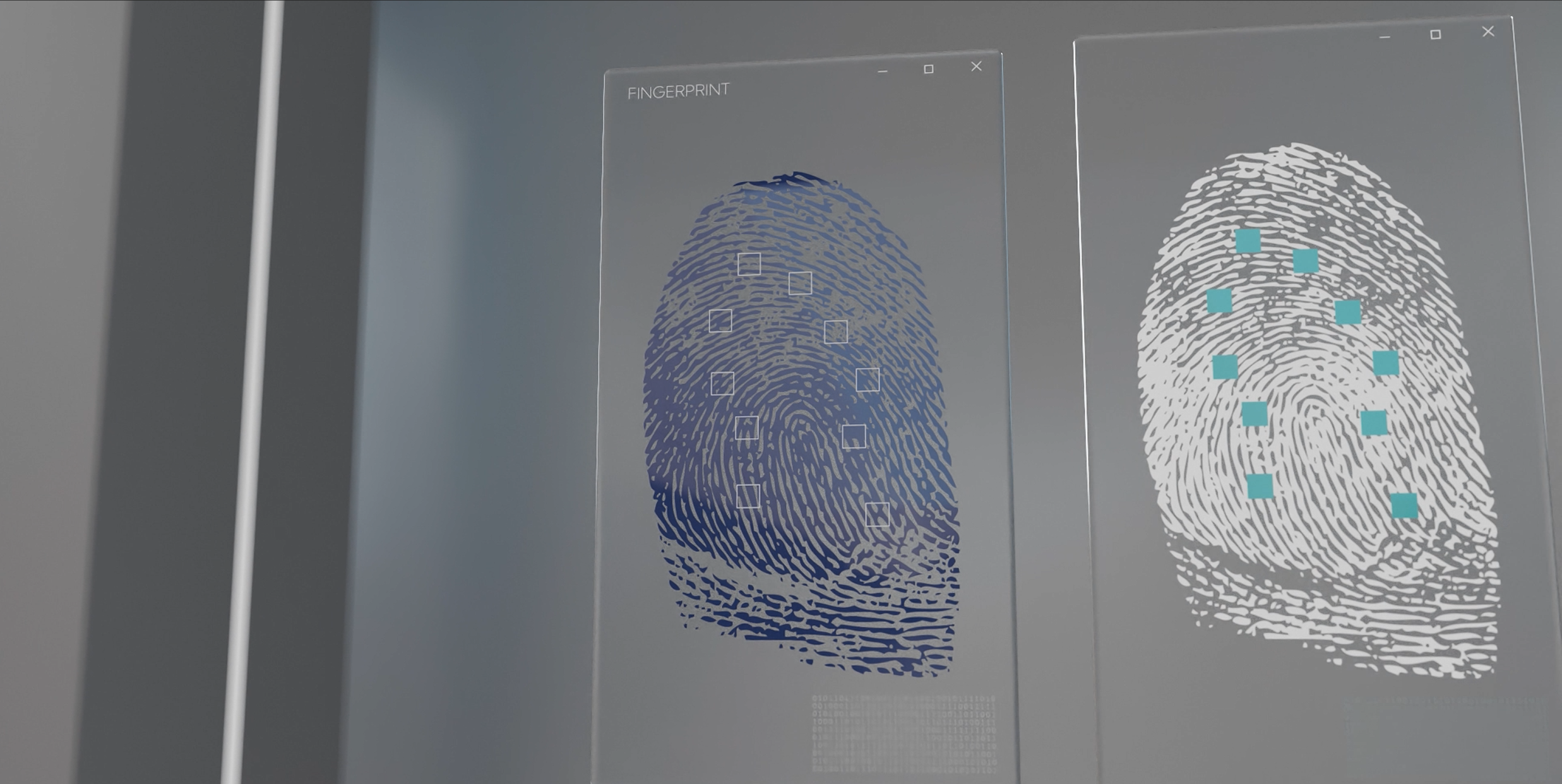
Capturing in three dimensions delivers richer, more accurate data — but the world’s current fingerprint infrastructure is built on 2D images. Billions of fingerprint records are stored across government and law enforcement databases worldwide — from India’s Aadhaar system to the FBI’s NGI in the United States— all in ISO/IEC 19794-4 Compliant 2D Image Format. Any new acquisition method must speak their language.
CFS bridges this gap through a proprietary unwrapping algorithm that transforms the captured 3D point cloud into a 2D grayscale image — geometrically equivalent to a plain print taken by contact-based methods. The output conforms to government and law enforcement standards, including 500 ppi resolution and FAP60 image format.
CFS is therefore not just a verification tool. It can be used for fresh enrollment into existing 2D fingerprint databases — no additional infrastructure required.
Not All Contactless Is Created Equal.
There are several approaches to capturing fingerprints without physical contact. Understanding why CFS uses a true microscopic 3D approach — rather than a simpler photographic or hybrid approach — requires understanding of the specific ways those alternatives fall short.
The problem with 2D photography
The most straightforward contactless approach is simply taking a photograph of the finger. Smartphone-based fingerprint capture works this way. It is also, technically, deeply problematic for any application that requires matching against legacy fingerprint databases.
Four distinct failure modes affect 2D photographic fingerprint capture:
Scaling. In a photograph, the apparent size of the fingerprint depends on the distance between hand and camera — information that is not captured in the image itself. Classical matching algorithms evaluate distances between ridge features (endings, bifurcations). Without an accurate scale, those comparisons become unreliable. The result: poor matching between contactless and contact-based scans, and even between two contactless scans of the same hand.
Perspective distortion. A finger is a rounded, three-dimensional object. When photographed from any angle, the papillary line structure at the edges of the finger is inherently distorted. The image cannot fully represent the true geometry of the ridges.
Light source dependency. In a standard photograph, the appearance of ridges and valleys depends heavily on the direction and intensity of the light source. Ambient light, the device’s own illumination, and reflections all influence which features are visible and how sharply they register.
Polarity inversion. Typically, ridges appear brighter than valleys in a fingerprint photograph. But under certain skin conditions or lighting situations, this contrast reverses. The resulting polarity inversion introduces false biometric information and significantly reduces identification accuracy.
The problem with 2.5D
A more sophisticated approach, sometimes called 2.5D imaging, combines a coarse 3D scan of the finger’s macroscopic shape with a high-resolution 2D texture image. The 3D information may come from photogrammetry, a stereoscopic camera, or a structured light scanner. The texture is then mapped onto this surface model.
This resolves the scaling and perspective distortion problems. But the light source dependency and polarity inversion issues remain, because the fine fingerprint detail still comes from a 2D photographic image rather than a true surface measurement.
True 3D: eliminating all four
CFS scans the entire surface of the finger in microscopic 3D. Because it measures physical surface geometry rather than photographing light reflection, it eliminates all four failure modes:
Scaling is resolved — the scan has an absolute positional reference, giving an accurate measurement of the finger and its features. Perspective distortion is eliminated by the 3D-to-2D unwrapping algorithm. Light source dependency is removed entirely, since the system is not capturing reflected light but surface geometry. And polarity ambiguity does not arise, because there is no photograph — ridges and valleys are physically measured, not inferred from brightness.
The micron-scale depth resolution of bluelynes technology makes this possible. At that level of precision, the distinction between a ridge and a valley is unambiguous.
Millions of Data Points. Microseconds to Capture.
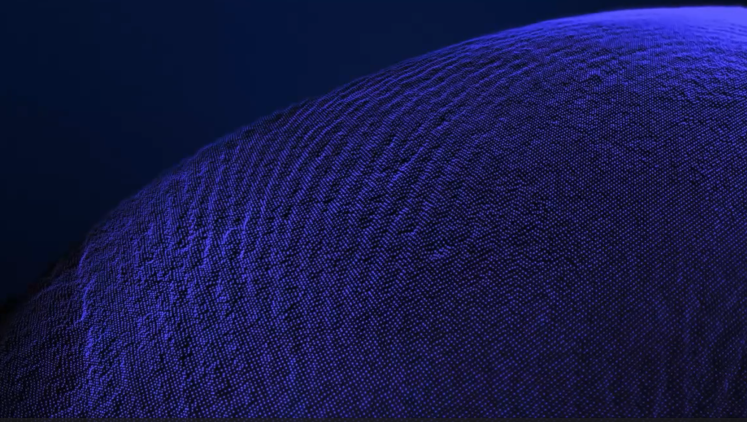
The density and speed of the bluelynes scan sets a new benchmark for fingerprint acquisition:
- Up to 8 million 3D data points per scan
- 13 point clouds generated per second during live capture
- Scan speed within seconds
- Micron-scale depth resolution
- Final image output in under 3 seconds, including processing and format conversion
- 500 ppi output resolution, meeting FBI and international government standards
This data density means that even faint, worn, or difficult fingerprints — common among elderly users, manual workers, or individuals with skin conditions — can be captured reliably where contact-based scanners frequently fail.
Built to Capture Under Any Condition.
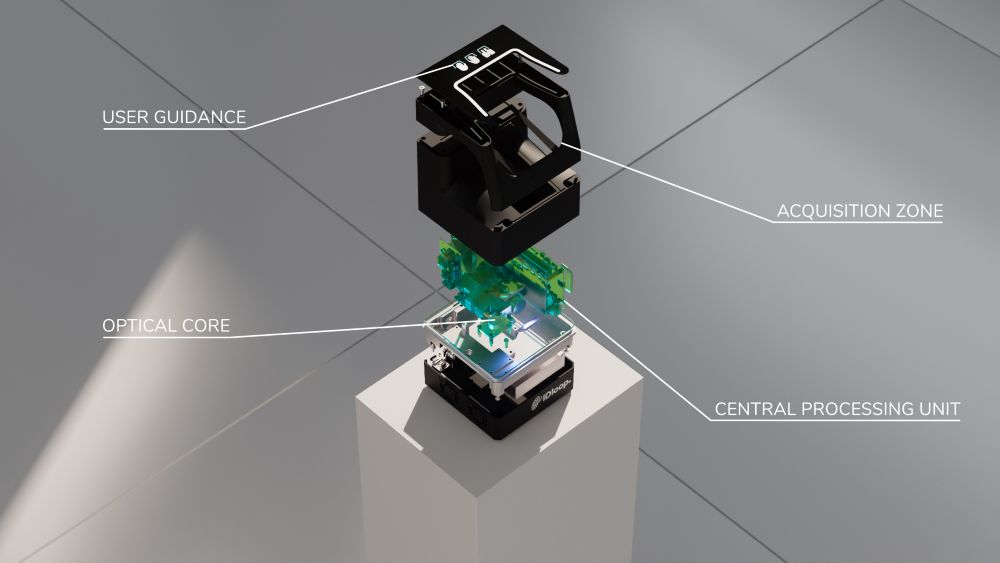
Real-world biometric environments are unpredictable. Lighting changes. People move. Skin is dry, wet, calloused, or scarred.
CFS operates independently of ambient light levels, functioning at up to 100,000 lux — including direct sunlight. The capture system is unaffected by skin tone, moisture, or minor movement during scanning. Because no contact is required, there is no pressure variable to manage, no smearing, and no partial print from misaligned placement.
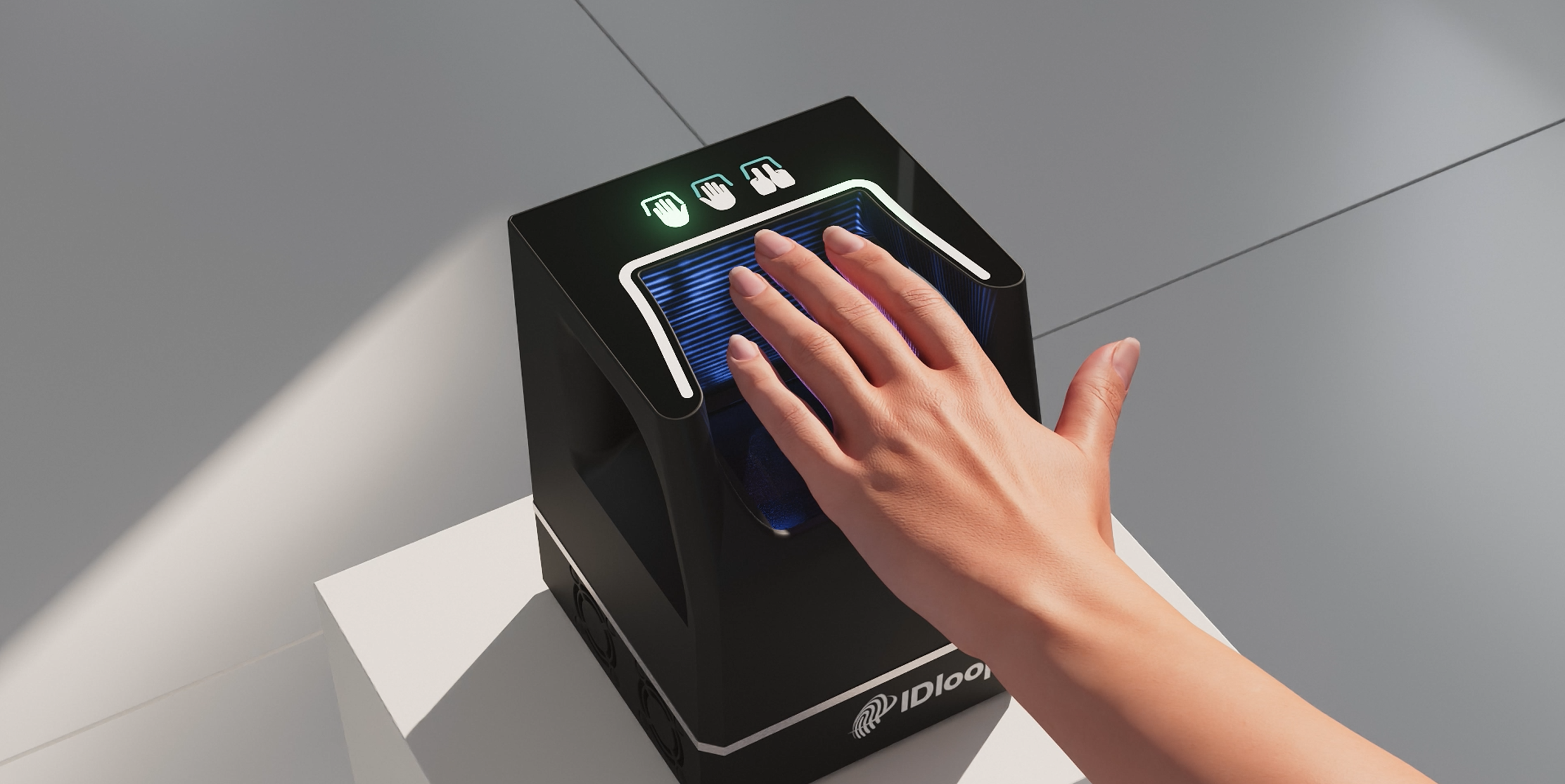
The system captures four flat fingerprints simultaneously, including thumbs, in a single acquisition — supporting standard 4-4-2 enrollment and verification workflows without multiple separate scans.